
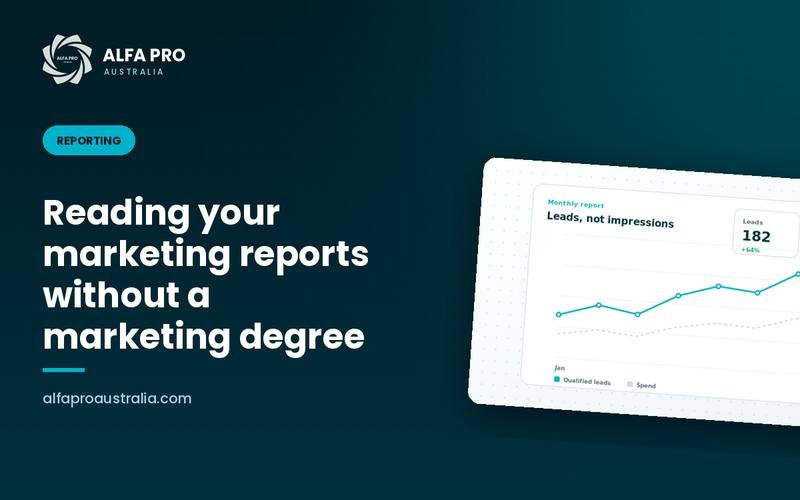
Marketing reports are often designed to look impressive rather than to be understood. That is a choice, and it is usually a bad sign.
Two numbers matter more than any other: what you paid to get someone interested, and what happened to them afterward. Everything else is context for those two.
Impressions and reach are diagnostics, not results
Impressions tell you how many times an ad was shown. Reach tells you how many people saw it. Both are useful for diagnosing a campaign and close to meaningless as a measure of whether it worked.
A campaign can have excellent reach and terrible results, and the reverse happens too. Ask what happened after someone saw the ad, not just how many people saw it.
Cost per lead and conversion rate, together
Cost per lead tells you what you are paying to get someone interested. Conversion rate — how many of those leads become customers — tells you whether the leads were any good.
Neither number means much alone. A cheap lead that never converts is more expensive than an expensive one that does. If a report shows cost per lead falling while your sales team says the leads got worse, both things can be true and you are being shown half the picture.
ROAS, in rough terms
Return on ad spend is simply revenue generated divided by the spend that generated it. A 4x ROAS returned four dollars of revenue for every dollar spent.
It is not a perfect metric — it ignores margin entirely, which is why a 2x ROAS can be excellent for a high-margin service and disastrous for low-margin retail. But it is a far more honest conversation starter than how many people saw an ad.
Attribution is a simplification, always
A lead credited to Google in a report often saw two or three other touchpoints first: an Instagram ad, a WhatsApp message, a friend's recommendation. Single-channel attribution is a convenience, not the truth.
This is exactly why channels should be judged as a system working together rather than ranked against each other in isolation. Turning off the channel that gets no credit sometimes makes the credited one stop working.
Questions worth asking your agency
What did we pay per lead this month, and how does that compare with the last three? How many of those leads became customers? What did you change, and why? What are you changing next month?
If a report leads with likes, followers and reach, ask for the leads and cost per lead instead. That is the conversation that actually matters — and a straight answer to those four questions tells you a lot about who you are working with.
A good report is short, honest, and readable by someone who does not work in marketing. If yours needs a translator, that is information too.
The short version
- Cost per lead and lead-to-customer rate are the headline numbers.
- Impressions and reach diagnose campaigns; they do not judge them.
- Understand ROAS, but always read it next to your margin.
- Treat single-channel attribution as an approximation.
- Ask what changed and what is changing next — every month.